
A Report From Wine Explorer
Diego Samper
Gordes, France
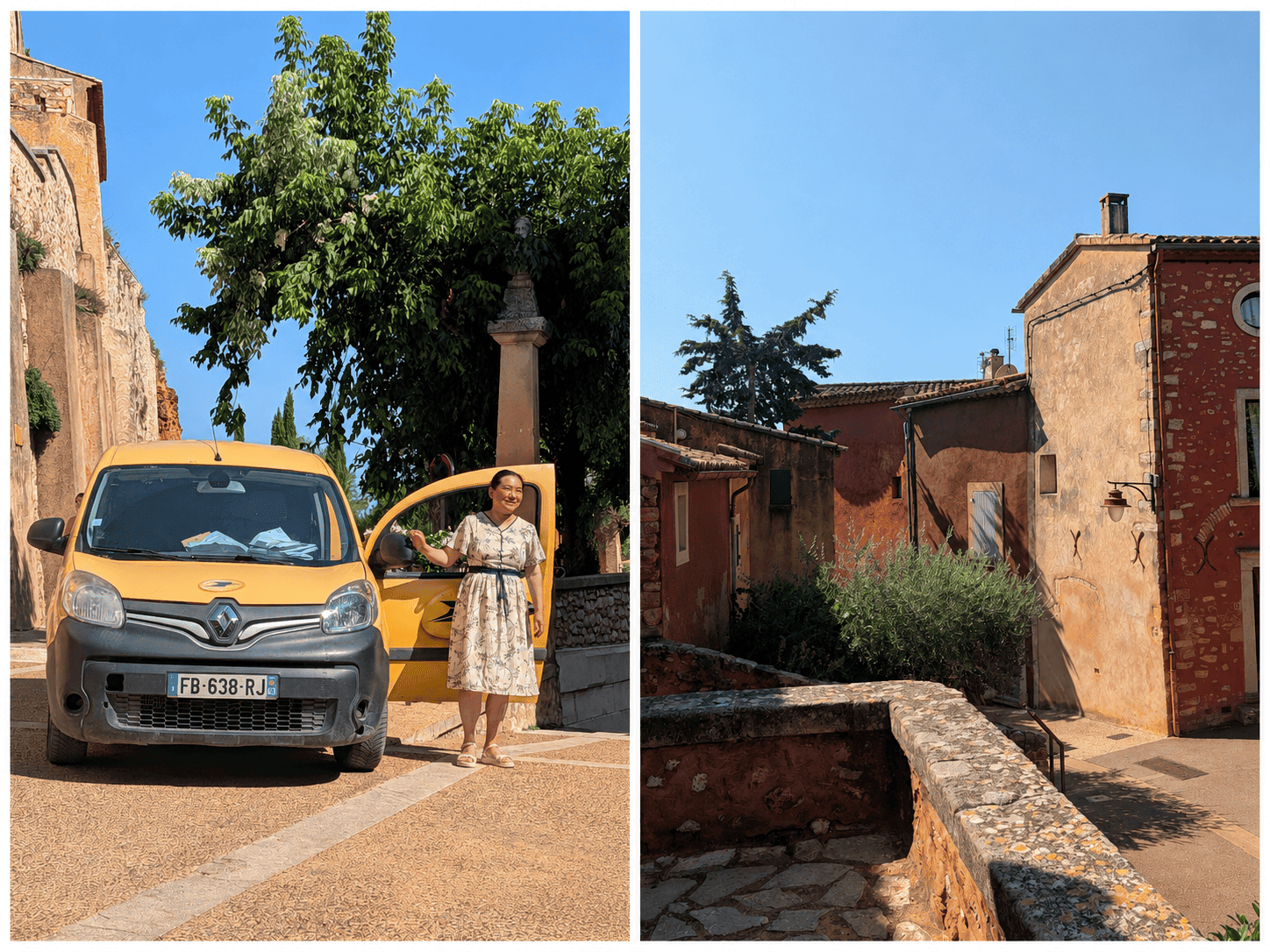
The yellow van, with La Poste written in blue cursive along its side, was parked in the middle of Place de la Mairie in Roussillon.
Not tucked near the curb or pulled discreetly to one side. Right in the middle of the square.
The mailwoman stood beside the open door with her phone pressed to one ear, trying to locate the person whose mail she was carrying. I could not follow every word, but the problem was obvious: the recipient was not where the recipient was supposed to be.
Her free hand moved through the air as the investigation widened. There was pointing, questioning, and the growing suspicion that somebody nearby knew more than they were admitting.
Around her, families kept taking photographs.
Roussillon makes that hard to resist. The village is small enough to cross on foot in half an hour, provided you do not stop for lunch, photographs, or whatever inquiry the mailwoman is conducting. Its buildings rise from the ochre earth in shades of peach, rust, apricot, and burnt orange.
Beyond them, vineyards and patchwork fields stretch toward Mont Ventoux and the Vaucluse mountains. The main attraction, though, is closer to your feet: ochre cliffs layered in yellow, orange, and red. The dust stains your shoes and clothes, and eventually ends up somewhere inside the rental car.
Younger visitors know exactly where to stand. Their parents read the plaques, look inside the church, and study the valley. Later, everyone ends up around the same table, eating whatever local food the region has put in front of them.
The square was posing for visitors while continuing the ordinary business of being a village.
Our trip south began as part vacation, part escape. Our son’s daycare in Paris closed for the summer, so we could stay in the apartment and pretend meaningful work would happen with a 1-year-old underfoot, or take a train south and rent a car.
We took the train. Forcing us to travel light.
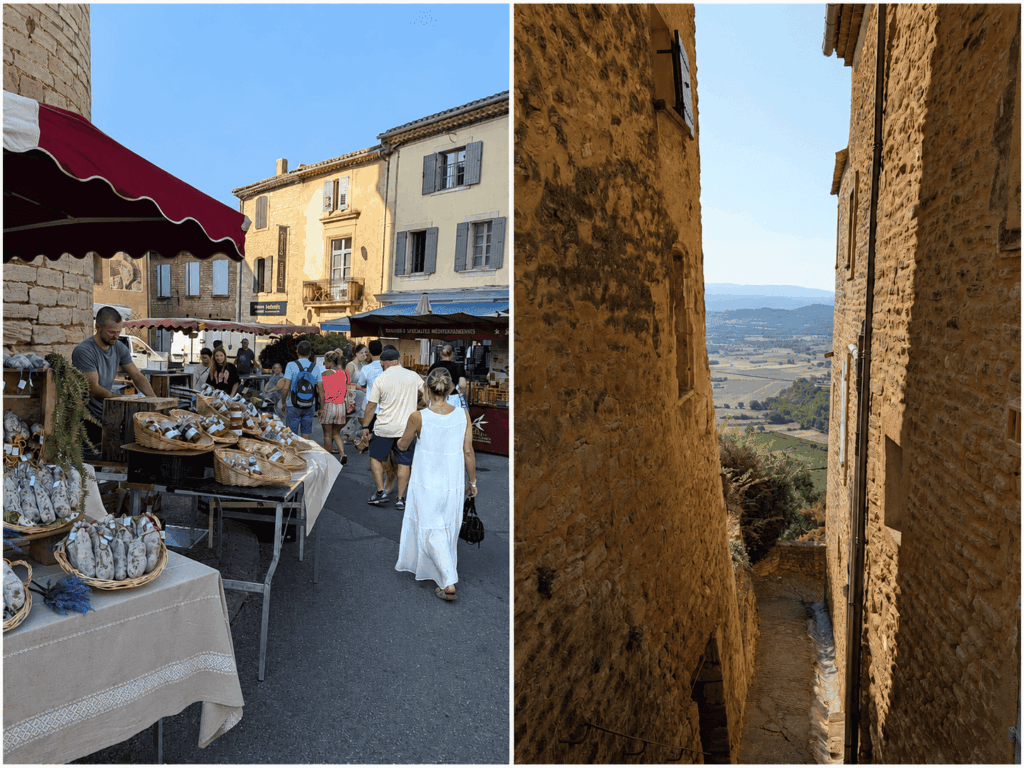
Gordes: Market day in the village, and the valley opening below its narrow stone lanes.
For the next five weeks, we will move through the south of France, including the coast. For now, we are near Gordes in the Luberon, an inland part of Provence known for hilltop villages, vineyards, lavender fields, and pale rosé.
It is also known for roads that seem to have been designed before anyone anticipated two-way traffic.
Between Murs, Gordes, and Roussillon, they twist past stone walls and dry hillsides. When another car appears, both drivers slow down, choose either the wall or the edge, and pass within inches without losing paint or dignity.
Around the next bend, some brave cyclist is climbing directly into the afternoon sun while your phone displays another temperature warning. Shade is scarce, the hills are long, and still they keep climbing.
The postcard version of Provence is all here: lavender, rosé, stone villages, and the hard southern light that makes everyone reach for a camera. Stay a little longer and the smaller details take over.
Peaches sit beside the road, ripe enough that you smell them before stopping. Thyme, rosemary, and savory rise from the dry ground. A church bell rings slightly off, as though one note has been missing for several hundred years.
That sense of place is not limited to the scenery. French villages have their own markets, foods, habits, and agricultural traditions. The mailwoman seemed to know that her missing recipient belonged somewhere in that square. The only question was where.
The Accent of a French Wine
French wine follows the same local logic.
In the US and Argentina, we often begin with the grape. Cabernet Sauvignon, Merlot, or Chardonnay usually appears clearly on the front of the bottle.
France often begins with the region or village: Bourgueil, Jura, Corbières.
The label forces you to dig a little further. France would never make it completely easy.
Think of the region as giving the wine an accent.
You may hear someone speak and recognize the American South without knowing whether that person comes from Georgia, Texas, or coastal South Carolina. The accent gives you a clue, but not the whole story. Two people from the same town will not sound identical.
Wine works much the same way. Bourgueil points you toward Cabernet Franc. The Jura has its own voice, including Trousseau. Corbières brings Carignan, Grenache, Syrah, and Mourvèdre into the conversation.
The appellation system reinforces those accents. To use a protected place name, a producer must work inside a defined area and follow its rules, including which grapes may be used.
A winemaker can experiment with something different. France will not confiscate the barrels. But the bottle may need a broader designation instead of the better-known appellation name.
The wine can still be excellent. It simply has to introduce itself differently.
Where Does This Bottle Belong?
The next time you open a French bottle, ignore the tasting notes for two minutes. Find the place on the label, locate it on a map, and look up the grapes traditionally used there. Then taste it again.
You may not identify every grape, but you will have a better idea of what accent to listen for and why the bottle sounds different from the one beside it.
As we prepare for our French collection this fall, I will use the next few weeks to build that map before we reveal the bottles.
Eventually, the mailwoman finished her call, closed the yellow van, and drove out of Place de la Mairie. The families stepped back into the street, and the photographs resumed.
She had spent the whole conversation trying to answer one question:
Where, exactly, did this belong?
French wine often asks you to begin in the same place.
Diego Samper
Wine Explorer