
A Report From Wine Explorer Diego Samper
Paris, France
Some of the most famous names in French wine aren’t French at all.
They’re Irish.
I discovered this on my first trip to Ireland, where I’d gone for an investment conference and somehow ended up drinking Guinness and following dead writers around Dublin.
Not a bad way to spend a Wednesday.
Bonner Private Wines had been invited to International Living’s Future of Wealth conference, led by Jeff Opdyke, who happens to know his way around a wine glass.
We brought along a little experiment with Dingle Crystal, a glassmaker on Ireland’s southwest coast.
Two glasses. Same wine. Different experience.
The idea was to see how much the shape of a glass could change what people smelled and tasted. People were surprised by the difference. I liked the craftsmanship so much that I bought a few whiskey glasses to take home.
You should try the experiment yourself sometime.
Once our tasting stand was ready, I had a few hours to kill.
Before arriving, I knew roughly four things about the Irish. They were friendly, they liked their beer, their food was built for surviving bad weather, and they had a habit of leaving the country to make fortunes elsewhere.
Some did rather well.
I’d asked Irish friends in Paris and New York what I should see.
Big mistake.
Within minutes, I had enough recommendations to fill two weeks. I had a few hours. So I thanked everyone, ignored almost everything they’d said, and caught the train from Dún Laoghaire into Dublin.
And I was lucky. The sun was shining.
Outside the window, Dublin Bay stretched toward the horizon. The tide was out, leaving enormous flats of wet sand and birds pecking away at whatever the sea had abandoned.
This was Sandymount Strand, where James Joyce sent Stephen Dedalus wandering in Ulysses.
I’ve never read the book. But I’ve spent enough time discussing it with my dear friend Joel Bowman, a Joyce fanatic, to know that Joyce managed to turn one ordinary day in Dublin into a literary monument.
His characters walk around, eat, drink, worry about money, think about sex, and make questionable decisions.
In other words, normal people. Without the courtesy of a happy ending.
I got off at Pearse Station with no plan beyond walking until something looked interesting.
First came St. Andrew’s Church, where Oscar Wilde was baptized. Then Merrion Square, where Wilde sits on a rock in a green jacket, looking rather pleased with himself.
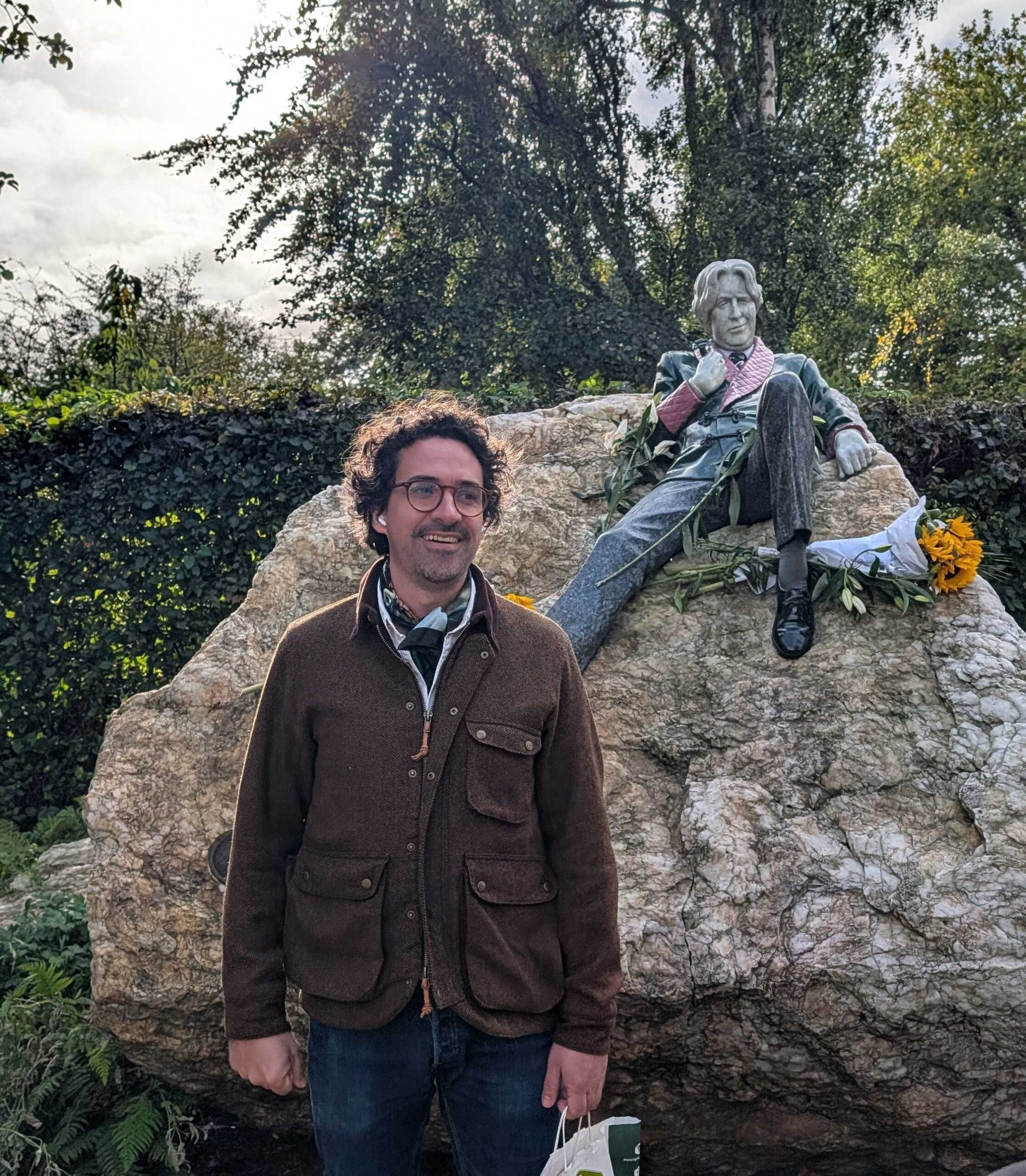
Across from him is a sculpture of Dionysus, the Greek god of wine.
Of course there was.
On a nearby stone pillar, I found one of Wilde’s lines:
“Nothing that is worth knowing can be taught.”
I stood there thinking about it.
I make my living finding unique wines. I’ve visited enough vineyards to know that the more you learn about wine, the less you seem to know.
You can spend years studying Burgundy. Then some old farmer pours you a glass in his kitchen and makes you question half of what you’ve learned.
I continued toward Trinity College, where Wilde and Samuel Beckett studied.
It’s a magnificent place. Centuries of people asking difficult questions, sometimes arriving at answers nobody particularly wanted to hear.
Not a fashionable occupation these days.
But what I enjoyed most about Dublin wasn’t the buildings.
It was the people.
The woman making my coffee. The man at the printing shop who helped me prepare conference materials. The hotel staff. The strangers who stopped to give directions.
They all seemed to have something going on behind their eyes. Stories, troubles, jokes. The sort of faces you want to sit across from at a bar.
And they were kind.
You could get lost in Dublin without feeling particularly lost.
Maybe I’ve been spending too much time in Paris.
Eventually, I got hungry.
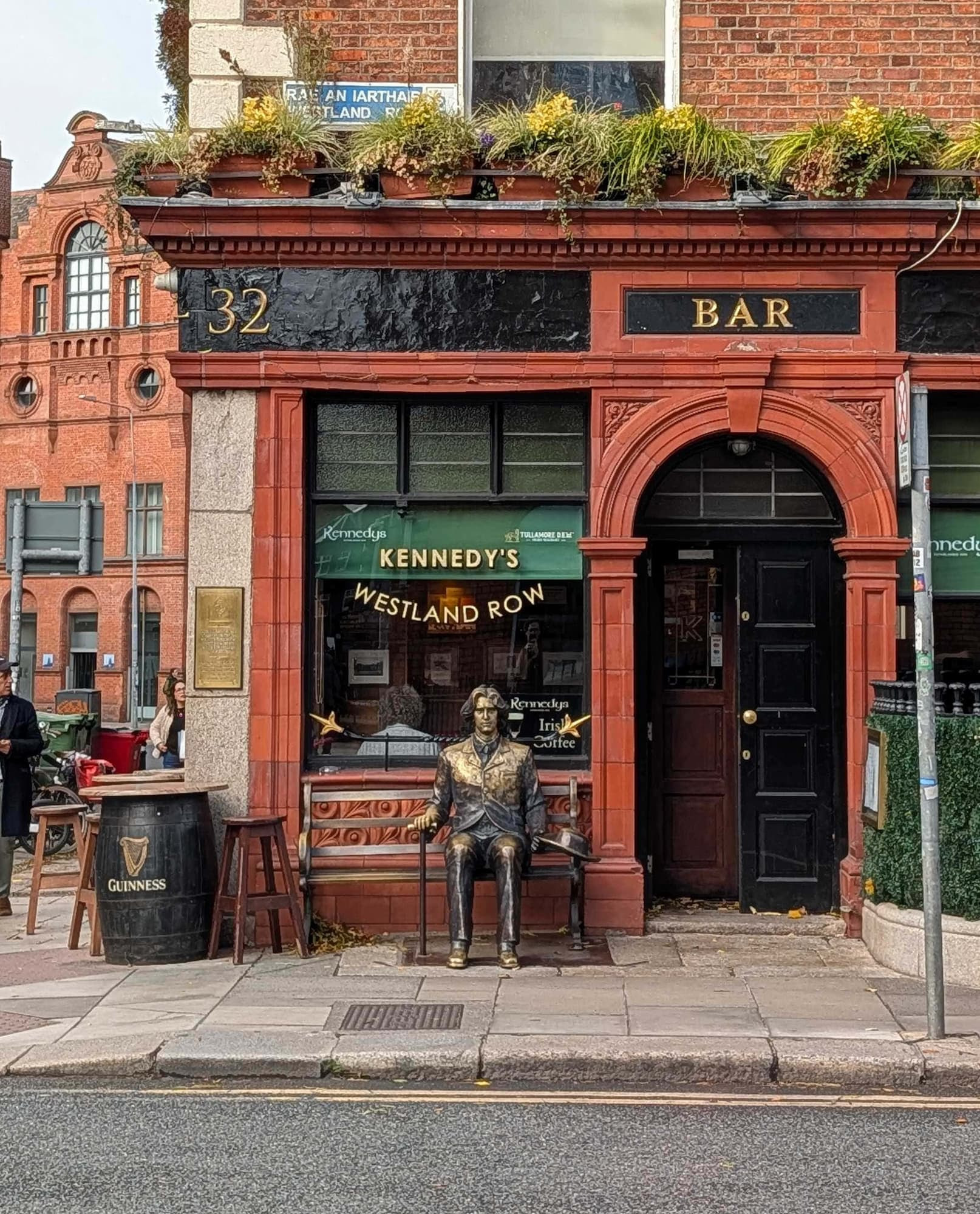
I found a stool at the Hairy Lemon and ordered a Guinness and a Dublin coddle.
Coddle is sausages, bacon, potatoes, and onions simmered together in broth. It’s not a dish that would win many beauty contests.
Mine arrived with mashed potatoes and bread. It was good. Better than it looked.
Around me, people were having their lunchtime pints.
In France, it’s a glass of wine. In Ireland, a Guinness.
I could get used to this.
The Irish Behind French Wine
Now, here’s something I hadn’t known.
Centuries ago, Irish families fleeing political and religious troubles began settling in France. Some became soldiers. Others went into business.
A number ended up in Bordeaux.
The French were perfectly capable of making excellent wine.
Selling it was another matter.
And the Irish, it turned out, were rather good at that.
They became known as the Wine Geese, a name connected to the Wild Geese, Irish soldiers and exiles who made new lives on the continent.
Some became merchants. Others bought vineyards. Names like Barton, Lynch, and Kirwan still appear on Bordeaux labels today.
Think about that.
Some of the most recognizable names in French wine came from Irish families who had packed their bags and started again somewhere else.
We talk endlessly about terroir. About wine belonging to a place, a soil, a family, a tradition.
Yet some of the families who helped build those traditions weren’t from there at all.
The French made the wine. The Irish helped find the customers.
A partnership I can appreciate.
From Bordeaux to Your Table
I suppose we’re doing something similar at Bonner Private Wines.
I’m not Irish, but I’ve crossed a few borders myself. These days, I spend much of my time finding wines in one country and getting them onto tables in another.
Making good wine is difficult. Selling it can be even harder.
We’re not trying to convince anyone to drink differently.
We’re looking for like-minded people who share our belief that there’s room for much better wine to be brought into America, and at better prices.
There are extraordinary wines being made by small producers around the world. The problem isn’t always the wine. It’s finding the people who will appreciate it.
The Irish understood that centuries ago.
And it brings me back to Wilde’s words in Merrion Square.
You can tell someone a hundred times that a lesser-known vineyard makes wonderful wine. You can explain the soil, the altitude, the family behind it.
But eventually, you have to pour them a glass.
That’s where the real conversation begins.
The Irish built quite a business bringing French wines to new customers.
We’re still working on it.
Our latest French Collection takes you through Jura, Bourgueil, Languedoc, and Corbières, with a Champagne from Reims.
No Irish Bordeaux this time. But some excellent French bottles that deserve a little more attention.
You can try the latest French collection for $275, just once, without a subscription.
I’d settle for someone opening one of those bottles over dinner next Friday.
Later, during a break from the conference, I stepped outside for coffee.
The wind hit first. Then the rain. Sideways, naturally.
I’d spent the previous day walking around Dublin in sunshine. Now I was getting soaked just trying to buy a coffee.
The locals didn’t seem particularly concerned.
Apparently, this was business as usual.
I didn’t get to see much of Ireland. A few streets, a university, a pub, some good people.
And an unexpected chapter of Bordeaux history.
I’ll be back.
Next time, I’ll bring a better jacket.
Perhaps I’ll even listen to my Irish friends.
Until next time,
Diego
The Wine Explorer