
A Report From Wine Explorer Diego Samper
Paris, France
Living in Paris has made me better at spotting fake handbags.
Not because I know much about handbags.
My partner works in fashion. She is the one who points things out: the shape, the stitching, the hardware, the leather. At first I mostly nodded.
Then you start seeing it yourself.
And once you see it, you can’t unsee it.
Fashion Week starts here on Monday. You notice before anyone tells you.
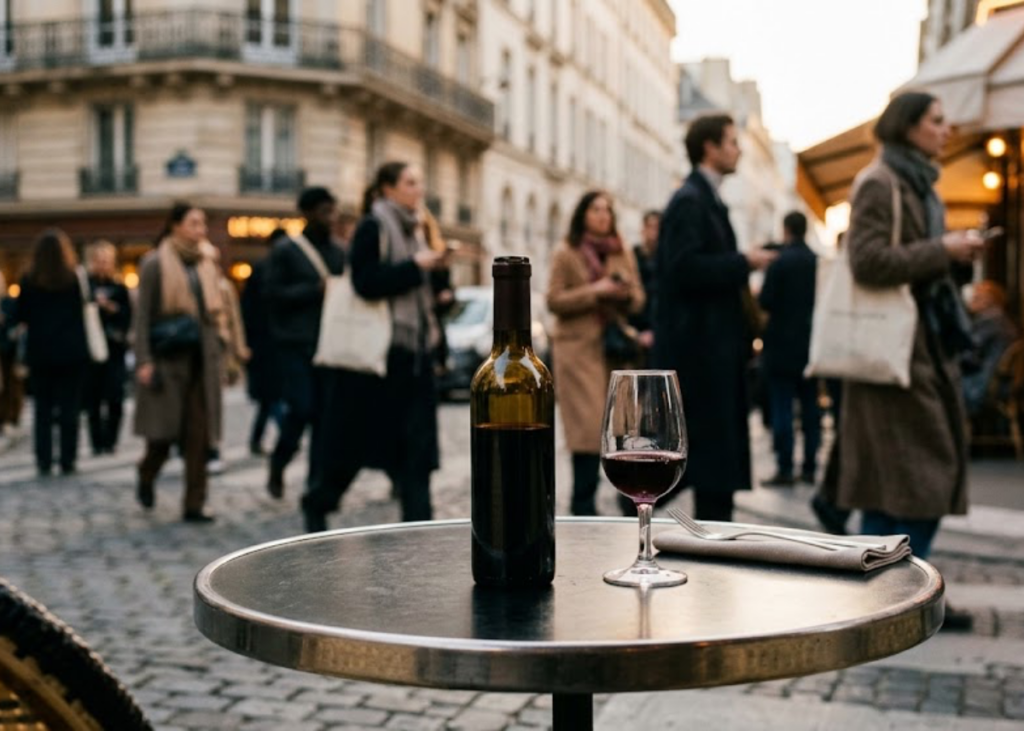
You walk out of your apartment and people are already coming out of the Metro dressed for a show, a cocktail, or wherever they are going next. The cool coffee shops fill up. People sit outside with suitcases waiting for an Airbnb check-in. Makeup artists carry their cases around. Designers, assistants, influencers, magazine people. Everybody seems to be going somewhere.
Le Marais gets packed. La Perle gets packed. Basically any place that has figured out how to sell coffee in one of its many modern variations gets packed.
Flat white. Matcha. Something with oat milk.
Walking around lately, I half expect Hugh Grant and Julia Roberts to come around the corner like we have wandered back into Notting Hill.
We seem to be back in the ’90s anyway.
Brown pants. Oversized jackets. Sunglasses I swear we have already owned once.
Fashion does this. Things disappear, come back, get altered slightly, and suddenly cost more.
Wine does it too.
There was ABC, “Anything But Chardonnay.” Merlot became uncool. Then natural wine became cool. Orange wine. Pét-nat. Amphora. Low intervention. Old ideas occasionally returning with new vocabulary.
Some of it has made wine much more interesting. Some of it has just made it look more interesting.
I don’t mind trends. They get people to try things. Sometimes they pull a grape or a region out of obscurity and make us look again.
But eventually you figure out what you like.
My partner can pick up a jacket she would never wear and still tell me why it is well made. Wrong color for her. Wrong cut. Doesn’t matter. She can see the work.
I like that.
It is increasingly how I want to approach wine.
Maybe I don’t love the grape. Maybe the style isn’t for me. Maybe the label looks like it belongs in a natural-wine bar in Brooklyn.
But was it made well?
That seems more useful than deciding whether it is cool.
How Did This Bottle Get Here?
Then you read that somebody paid to get to the front of the line.
That caught my attention.
Earlier this month, Southern Glazer’s Wine & Spirits, one of the largest alcohol distributors in the US, agreed to pay $12.5 million under a non-prosecution agreement with federal prosecutors. The company acknowledged responsibility for improper payments and benefits connected to the promotion, purchase, maintenance, and placement of certain alcohol products.
The legal details are not what stayed with me.
The word was placement.
That is how the bottle gets in front of you. The shelf. The restaurant list. The display at the end of the aisle. The wine you suddenly seem to see everywhere.
And every once in a while you look at one and wonder:
How did you get here so fast?
There is nothing wrong with marketing. There is nothing wrong with distribution. There is nothing wrong with a good salesperson getting a wine in front of a buyer. Without all of that, most of the wines I love would never make it anywhere near your table.
But there is a gentleman’s agreement buried somewhere in the process.
You trust the people bringing wine to market to put something worthwhile in front of you.
Not blindly.
Just enough.
I suppose I still want wine to work a little like getting into an Ivy League school. You do the work, prove yourself, and somebody eventually lets you through the gate.
Of course, we all know there are buildings on those campuses carrying the names of people who found another route in.
That is what bothered me about the Southern Glazer’s story. Not that big distributors sell bad wine. They don’t. It is that a story like this makes you look at the machinery again.
Once you start asking how something got there, you can’t unsee that either.
What Was Made Well
Maybe that is also why I still get excited about small producers.
Not because small means good. It doesn’t. Obscurity can become its own fashion.
But sometimes you taste something from a producer who has never had the money, connections, or scale to get very far beyond home and think: this deserves a chance.
Meanwhile, I’m already tasting for January and April.
And for January’s Partnership Collection, I’m bringing in a winery that has never exported before.
Nobody here knows the name yet. No decades of American distribution. No famous label making the introduction.
We can get the bottle through the door.
After that, frankly, it is between you and the wine.
If you want to come along, the next Partnership Collection ships in October, with January already taking shape behind it.
We have a few spots left so if you’re interested, reply here.
Fashion Week will finish. The crowds will disappear. The oversized jackets will eventually shrink again. Somebody will decide brown is over, until it isn’t.
Wine will find another grape, another region, another old technique to fall in love with.
That part is fun.
But spend enough time around either clothes or wine and I think you become less interested in what is having a moment and more interested in what was made well.
Maybe that is the gentleman’s agreement.
I’ll bring the craft.
You bring the glass.
Diego
The Wine Explorer