
A Report From Wine Explorer Diego Samper
Paris, France —
Dear friends,
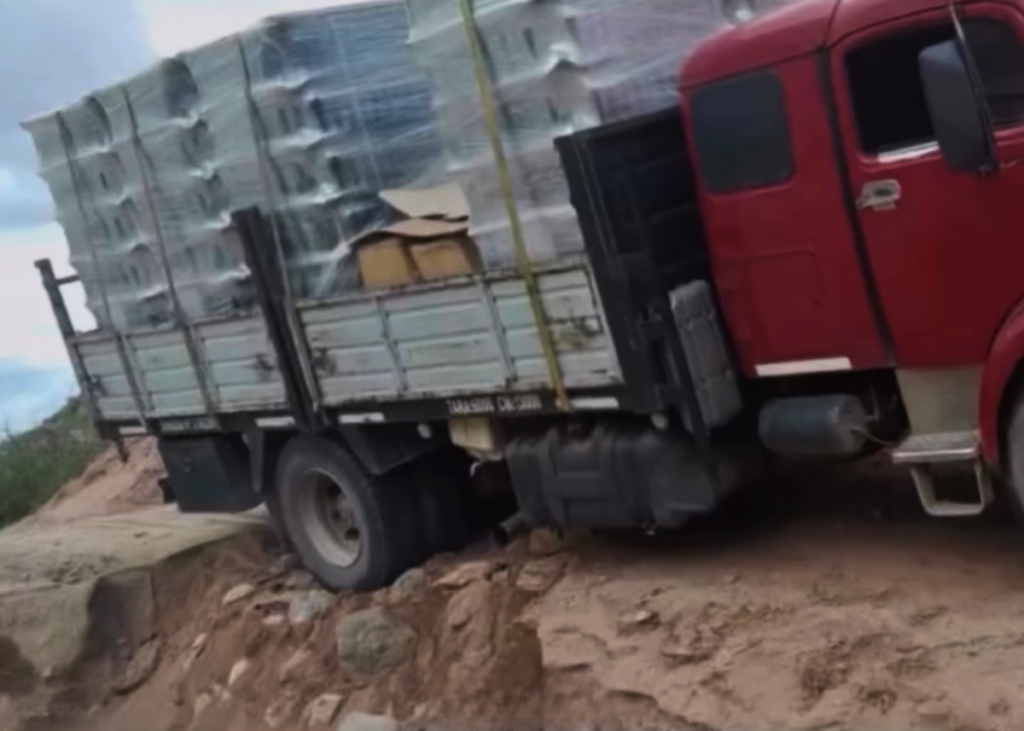
The truck wasn’t stuck.
It was hanging there.
A small two-axle truck, four pallets loaded, easing down a dirt road cut into a hillside. After heavy rain, the edge began to crumble. One rear tire slipped toward open air. The road didn’t collapse completely. It just started to go.
That’s worse.
The note under the photo read: “People say it’s expensive. I say difficult.”
That line stayed with me as I walked into Wine Paris.
Because difficulty rarely shows up on a price tag.
Wine Paris
Wine Paris is a cathedral of confidence. Clean lines. High ceilings. Polished stands. Conversations about positioning and expansion. Outside one Champagne house, a Bugatti sat under soft lighting like an artifact.
It was beautiful.
It was also not the road in that photograph.
A few aisles away, a producer poured quietly into my glass. Boots. No theater. No lighting crew. Just someone who has dirt under his nails and no interest in spectacle.
Both worlds exist.
Only one understands gravity.
This year felt less like discovery and more like alignment.
Producers Who Hold Their Line
I spent time again with Cascina Galarin from Piemonte. Their wines don’t strain for attention. They hold their line. Structure first. Personality second. That order matters.
I saw Más Viella. The first time we tasted them, someone whose palate I respect said simply, “This is your kind of estate.” No story. No hype. Just wine that didn’t beg to be liked. I admire that.
Argentina was well represented this year.
Domingo Molina and Agustín Lanús brought that northern austerity I’ve come to respect. There’s something about the dryness up there, the light, the distance from everything comfortable, that shows up in the glass. No softness added for applause.
Raúl couldn’t attend. His cousin Pepo of Tacuil stood at the table instead. And beside him was Ovidio from Seclantás.
Ovidio is Romanian by birth, French by residence, Argentine by commitment. Twenty years ago, he planted vines in Argentina. He still lives in France. Every year he returns to oversee the vineyard personally. He does not make the wine. Raúl vinifies it. Ovidio guards the principles.
He is uncompromising.
No shortcuts in farming. No cosmetic adjustments in the cellar. He cellars his wines at least five years before release. Minimum. Not because it is fashionable. Because he believes they are not ready before that.
He is a purist in the vines and in the wine.
I respect that deeply.
In a room full of urgency, he is patient.
Provence and Family
In Provence, I spent time with Paul from Jas Monges. He poured without speaking much. Watched reactions carefully. His father stepped in and began asking questions about our club. Where do the bottles go? Who drinks them?
Paul shifted slightly, as if the logistics mattered less to him than what was in the glass.
No polish. No choreography. Just family.
The wines were direct. Clean lines. Nothing ornamental.
Scale vs. Substance
Throughout the week, smaller producers spoke quietly about how concentrated the US market has become. A few large importers control much of the distribution. For an independent estate, entry is not about quality alone. It’s about scale.
I listened.
There is a difference between scale and substance.
The families we work with operate on substance.
They are not optimized for speed. They are not designed for rapid expansion. Some of them release late. Some refuse to bend style to trend. Some reject suggestions that would increase volume but soften identity.
It is slower.
It is narrower.
It is more exposed.
Like that road.
When you open one of these bottles, you are not participating in a performance. You are stepping into something that required restraint. And sometimes restraint is the harder path.
The truck in the photograph did not fall.
But it could have.
That is the part people do not see.
People say it’s expensive.
Often, it’s just difficult.
And difficulty — when rooted in principle — tends to outlast fashion.
Ovidio’s wine will be in our next collection. It has already waited longer than most producers are willing to wait. If you value that kind of discipline, you will recognize it in the glass.
Until next week,
Diego
Wine Explorer