
Dear Member,
From its Trans-Caucasian origins, wine likely came to western Europe with the Phoenicians around 1,000 B.C. We don’t know much about the Phoenicians. They left behind no written record. And the ancient Greeks get most of the credit for introducing grape growing and the wine trade on a larger scale. From them, the Romans took up the practice, going on to develop Europe’s great terroirs (save Bordeaux).
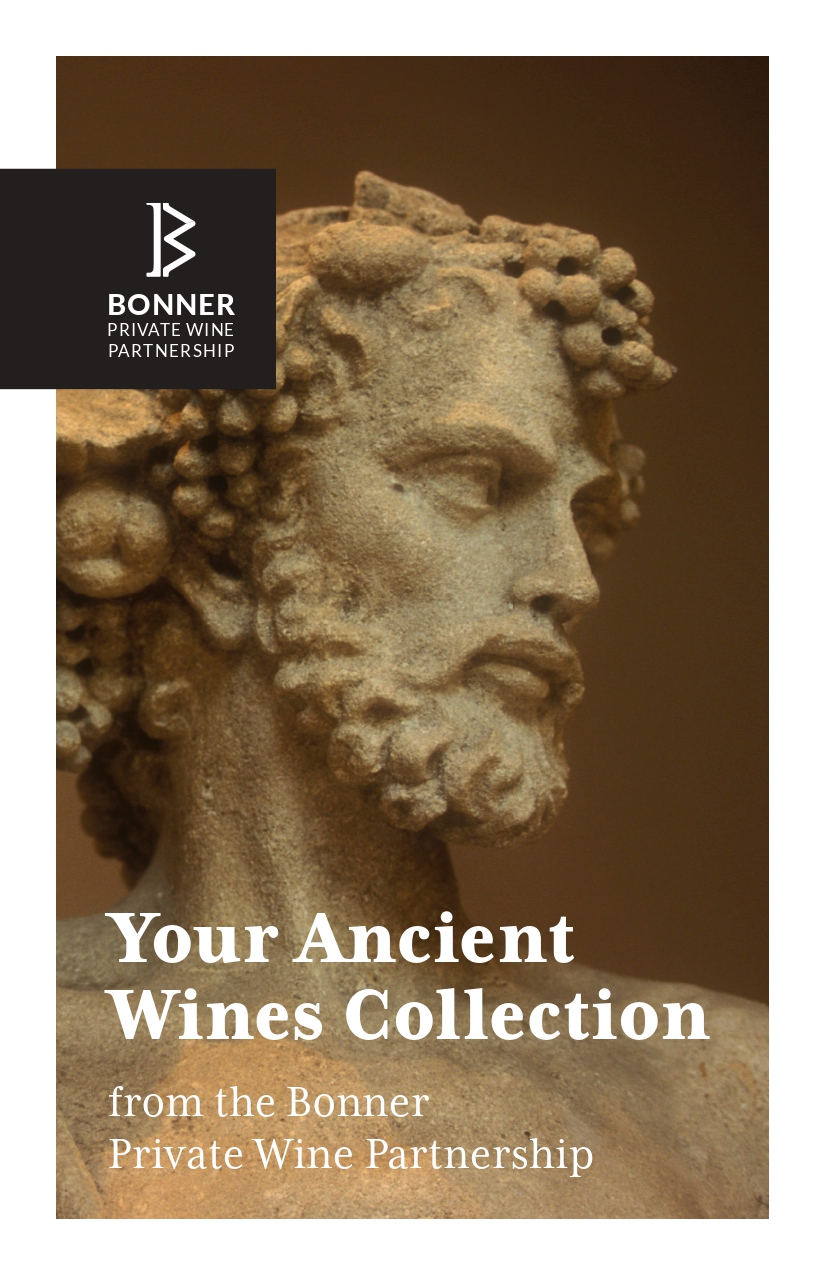
With the wines you’ll find in this collection, we follow in those ancient footsteps—from the Greek colonists who washed up on Italy’s hills, to the Roman phalanxes sent to guard the vineyards in Germania Superior.
From Oenotria to the Roman World
We begin in the 8th century, when the Greeks arrived in what they called Oenotria, or the “land of vines.” They had discovered Italy. There, they passed on their know-how to the locals, namely the Etruscans, who made wines up in the hills by the Tyrrhenian Sea—an area now known as Tuscany.
It was the Etruscan king Porsena who founded Montepulciano. The same man put the Etruscan civilization squarely on the wrong side of the nascent Roman Republic when he attempted to restore the Roman monarchy to power. Soon enough, Etruscan culture was on the wane, eventually absorbed into the Roman sphere.
From Italy, the Greeks pushed west and north, first establishing a trading post in Provence, then, in the 5th century, continuing to Languedoc at the mouth of the Rhône River. While it is unclear whether the Greeks themselves ever left the coast, their wines appear to have made it as far north as Alsace, where Gothic kings drank them from clay amphorae.
Iberia, Gaul, and the Reach of Rome
The Spanish coast, too, felt the influence of the Greeks—though the Phoenicians had most certainly brought grapevines there before them. As in Italy and France, the Romans would continue, and improve upon, the viticulture both civilizations left behind. Under the Roman Empire, Catalonia was one of Europe’s major producers.
In his Natural History, Pliny the Elder noted how the area, and specifically Tarraco (present-day Tarragona), was “esteemed for the choice quality of their wines.”
The Romans were the first to make wine a product that could be produced at enough volume to quench the thirst of the then-known world. Their operations extended as far north as Argentoratum, in Germania Superior, a city built partly to protect one of the empire’s prized centers of winemaking. Today, it is known as Strasbourg, in the Alsace region.
The Wines in This Collection
In this collection, you’ll find the following wines:
Tenuta Vallocaia Bindella 2018
Campidivini La Chiusa Toscana 2015
Calmel & Joseph Entre Amis 2019 / 2020
Vieil Armand Rendez-vous 2020
Dominio del Bendito El Buen Rollo 2019
Mascaró Cava Gran Reserva 2014 / 2015
Each bottle has a unique connection to the history we’ve shared with you here, with a distinct line extending back through the millennia to the ancient hands—Roman, Etruscan, Greek, Phoenician—that birthed a drink like no other.
Enjoy!

Will Bonner
Founder, The Bonner Private Wine Partnership
P.S. You’ll notice that we have two vintages of some wines in stock. Due to extremely limited production, getting only one vintage was not possible. However, we felt (1) that the wine would be a shame to miss out on no matter the vintage, and (2) that both vintage years were representative of the overall quality and character of the wine.
If you’d like to try the other vintage year, you can always reach out to us to set some aside for re-orders.